Steel Strip Services: The Slitting Process (Roll Slitting)
Slitting (Roll Slitting) is a precise cutting operation on metal sheet in which the “master coil” (a heavy, wide coil of sheet) is converted into narrower, lighter coils of smaller width. The main purpose of this process is to produce strips in custom widths for easier and more specialised use across many industries.
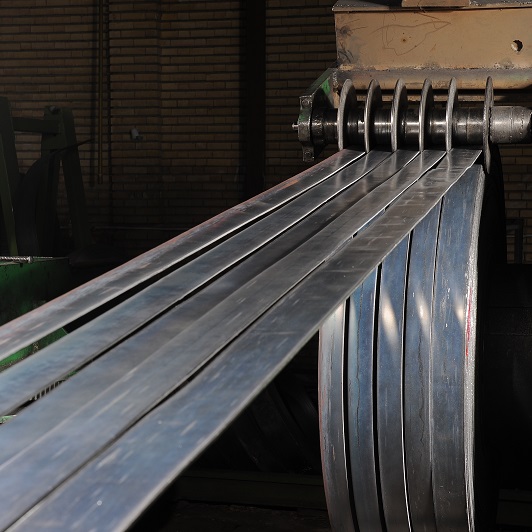
1. Main Slitting Methods
Slitting of all types of sheet (including black, oiled, galvanized, pre-painted, stainless steel and aluminium) is carried out using two main methods:
A) Stationary Slitting
- How it works: without fully uncoiling, the metal coil rotates on two rollers and is slit as the cutting blade is lowered.
- Application: this method is usually used for light, thinner coils with a small diameter, since heavier coils require larger blades.
B) Rotary Slitting
- How it works: the steel coil is opened on the decoiler and fed into the slitting line. After passing through the slitting knives (whose spacing is set by digital systems and the operator), the sheet is cut into narrow strips and recoiled as lighter, narrower coils (on a shaft) at the end of the line.
2. Capabilities and Technical Dimensions of Our Slitting Lines
Slitting machines are designed according to customer requirements (material type and thickness, required accuracy).
Line categories by cutting thickness:
Slitting lines are divided into three groups according to the thickness they can cut:
- Thin-gauge slitting lines
- Medium-gauge slitting lines
- Heavy-gauge slitting lines
Maximum technical specifications:
| Property | Production Range |
| Speed | Up to 120 m/min |
| Cutting Thickness | 0.2 to 6.00 mm |
| Strip Width | 15 to 1500 mm |
| Accuracy (Tolerance) | Less than 0.1 mm |
| Coil Inner Diameter (ID) | 40 to 60 mm |
| Coil Outer Diameter (OD) | Up to 1800 mm |
💡 Note: the inner and outer diameters of slit coils can be adjusted depending on the machine and the customer’s order.
3. Applications of Slit Strip
Slit steel strips are a vital raw material in many industries:
- Construction and structures: production of galvanized profiles (for drywall ceiling framing), expanded metal lath and UPVC windows.
- Heating, cooling and electrical industries: slit stainless steel and copper strips.
- Automotive and shipbuilding
- Packaging industries: armoured cables, tanks and drums.
- Home appliances: industrial hardware (such as cabinet rails) and kitchenware.
- Large storage tanks and tankers.